
Fashion Innovation Day is once again bringing the fashion industry together to explore the future of retail
18 | 03 | 2026
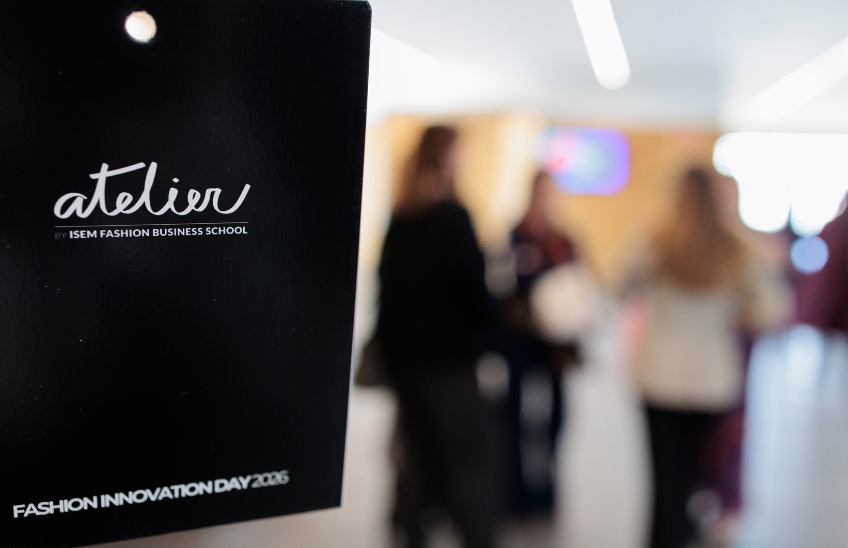
The fifth edition of Fashion Innovation Day, held at ISEM Fashion Business School, took place in an atmosphere that perfectly captured the essence of the Atelier project: a meeting place where companies, experts, and entrepreneurs come together to analyze, with rigor, data, and a business-oriented perspective, the direction in which the fashion retail industry is heading.
María Martín-Montalvo, Director of Institutional Relations at the business school, opened the event by noting how Atelier, now in its fifth year, has established itself as Spain’s leading FashTech innovation forum—a space where academia and industry work hand in hand to identify solutions that transform the sector’s value chain.
From there, the morning unfolded as an exploration of the major questions shaping today’s retail landscape. Víctor Martínez de Albéniz, a professor at IESE Business School, kicked off the discussion with a broad overview of the retail industry: from the mass-market model of the 1950s—when mainstream consumption was based on the “everything for everyone” approach—to the present day, where that paradigm has vanished. Using the case of Zara and its ability to turn data into rapid decisions, he demonstrated how the store has become an active element—a space where operational efficiency, brand experience, and technology converge. His concluding reflection, which served as a common thread throughout the morning: it is not enough to introduce new tools; what needs to be redesigned are the processes that underpin the relationship with the consumer.
That approach tied in naturally with the presentation by Carlos Molina ( Multiversial), who posed five business questions that every fashion company should be asking itself today. Using everyday examples—from self-service to the digital experience—he explained how today’s consumers are more actively involved than ever in their purchasing process and how this shift is forcing brands to reduce uncertainty, clarify their value proposition, and decide which parts of the business should rely on automation and which should preserve human judgment. He also addressed a fundamental dilemma: in a data-saturated environment, what distinguishes a company that follows trends from one that is capable of creating them? His presentation concluded with a provocative question that resonated with the audience: if we delegate too much thinking to AI, will we end up needing “gyms for the mind”?
Rosa Fernández-Velilla ( Prompt Couture AI) wrapped up the morning session by grounding the discussion in the realities of the business world. She demonstrated how generative AI is already transforming design and marketing—from converting mood boards into product proposals to content creation—and how these tools can improve gross margins. But her message was clear: technology only works if it is accompanied by training and reskilling, and if we do not lose sight of the fact that fashion still needs to generate desire. Without aspiration, there is no brand, and without a brand, there is no technology that can sustain it. AI, she insisted, must serve to create new value, not to do the same thing more cheaply.
With these three perspectives—strategy, data, creativity, and technology—the morning concluded with a shared insight: the industry is at a point where it is essential to rethink processes from top to bottom. A genuine conversation among those who are transforming retail today.